i. The Fool's Fall
I make special fluffy omelets, which requires a pan and a lid so it fluffs up like a cloud. Even though i adore my cast iron plate, my lid situation is not yet resolved. But a new appliance entered the kitchen, so here starts the fall into quiche and airfryer
ii. What is this thing?
A quiche is an open-faced savoury tarta baked pastry case — open on top, no lid — filled with a savoury rather than sweet mixture with a custard filling. The custard is simply this: eggs whisked together with cream or milk, poured raw into the shell, and baked until the egg proteins set and the whole thing holds its shape as a soft, slightly wobbly slice.
If you cut into one, what you find is a golden pastry base about 2–3 mm0.1 in thick, then a filling somewhere between a soft omelette and a set cream: pale yellow at the centre, golden at the edges where the heat caught it, silky and yielding. It smells of browned butter and egg. It tastes rich and slightly eggy with whatever savoury element you added — lardonssmall rectangular-cut strips of cured smoked pork belly, distinct from English bacon rashers in cut, cure, and fat content — the classic Lorraine filling bring smokiness, cheese brings sharpness, spinach brings very little flavour but good colour.
iii. Are you hungry?
Four different quiches, one for each kind of cook. The cards below go from most accessible to most aspirational — start where you are. After the recipes: the two things that go wrong, and the dishes quiche is most often confused with.
Four ways in — one for each cook
SIMPLE
Anyone can do this tonight. Common ingredients, 8–10 minutes, no pastry, no skill gap.
Justine, The Typical Mom (temeculablogs.com, US) — Justine runs a family cooking and activities blog she started in 2012. She raises chickens; her egg-based recipes come directly from what she collects that morning. This crustless quiche takes minutes: no shell to make, no blind-baking, just eggs whisked with whatever is in the fridge.
Ingredients (serves 1): 3 eggs · ¼ bell pepper, diced · ¼ cup (≈ 60 ml) diced onion · 2 tablespoons (≈ 30 ml) milk · 2 tablespoons (≈ 30 g) shredded cheese · ¼ teaspoon thyme · salt and pepper · olive oil spray Method: Preheat the air fryer to 325 °F163 °C for 10 minutes. Whisk eggs; mix in all remaining ingredients. Spray a 4-inch (≈ 10 cm) oven-safe ceramic dish. Pour the mixture in. Cook 8–10 minutes until the centre is set. Rest a few minutes before serving.
Substitutions: Any vegetable works — mushrooms, courgette, cherry tomatoes. Add cooked bacon or ham for a Lorraine-adjacent filling. No cheese? Skip it — the egg will still set clean. Gluten-free as written (no flour).
PRACTICED
For the cook who wants proper Lorraine flavours without the pastry. Assumes you've made the simple version and want more depth.
Beth Sachs, Effortless Foodie (UK) — Beth is a home cook from Cornwall who has cooked for a household of five for years and builds every recipe around the principle that good food should not require a cooking degree. Her crustless quiche Lorraine keeps all the classic flavours — pancetta, cream, egg — and skips only the pastry. The technique step up here is the stovetop sauté before the air fryer: cooking the onion and pancetta first builds a flavour base the simple card skips.
Ingredients (serves 4–6, baked in a 20 cm≈ 8 in tin): 10 g0.35 oz butter · 1 onion, finely chopped · 280 g10 oz pancetta (or smoked bacon lardons) · 6 large eggs · 150 ml5 fl oz double cream · 50 g1.75 oz grated Parmesan · pinch of nutmeg · salt and pepper Method: Preheat the air fryer. Line a 20 cm8 in baking tin with parchment. Cook onion and pancetta in butter for 6–7 minutes until soft. Whisk eggs, cream, cheese, and seasonings; fold in the cooked mixture. Pour into the tin. Air fry at 180 °C356 °F for 20–25 minutes until set and golden. Cool for 10 minutes before slicing.
Substitutions: Swap pancetta for smoked streaky bacon. Double cream can be replaced with crème fraîche for a sharper note. Leave out the cheese if you want the purist version — the egg and cream do the structural work without it.
Recipe: effortlessfoodie.com/air-fryer-crustless-quiche-lorraine
EXPERT
Special-occasion quiche. This is the canonical form — the dish the Confrérie would recognise.
Stéphane, The French Cooking Academy (Australia) — Stéphane grew up in Fontainebleau, France, moved to Australia, and realised he had no idea how to cook the food of his own country. He taught himself from the actual culinary school textbooks — not shortcuts, not feel — and built a channel and online school that now teaches French technique to home cooks worldwide. He is not a celebrity chef; he is someone who went back to the primary texts and learned them properly. His quiche Lorraine uses the migainepronounced mee-GAYN — the traditional Lorraine term for the egg-and-cream custard that fills a quiche that the Confrérie de la Quiche LorraineBrotherhood of the Quiche Lorraine — a gastronomic fraternity based in Dombasle-sur-Meurthe, reconstituted 2015, guardians of the three-ingredient recipe would recognise.
Filling (the migaine): 3 whole eggs · 300 ml10 fl oz heavy cream · salt and pepper Garnish: 150 g5.3 oz smoked lardons — the fat must render slowly into the custard Crust: 1 batch classic pâte briséeFrench short-crust pastry — a fat-rich, crumbly dough where butter is rubbed into flour before any water is added, preventing gluten development, rolled to fit a 24–26 cm9.5–10 in quiche pan, chilled 15 minutes minimum before baking Method: Blind-bakepre-bake the empty pastry shell, weighted with baking beans over parchment, so the base sets dry before the wet custard goes in — the step that prevents a soggy bottom the chilled shell at 180 °C356 °F for 15 minutes, then unlined for another 5. Pan-fry the lardons over medium heat until crisp; drain. Whisk cream with eggs; season lightly (the lardons carry salt). Spread lardons over the baked shell; pour filling in. Bake at 200 °C392 °F for 10 minutes, reduce to 180 °C356 °F for 20 minutes for a metal pan; or at 180 °C356 °F for 25–30 minutes for a ceramic dish. Done when the edges are set and the centre still has a very faint wobble.
No cheese. No onion. Three ingredients — eggs, cream, lardons — and this recipe is the reason the rest of the article exists.
Masterclass: thefrenchcookingacademy.com/recipes/authentic-quiche-lorraine
HYPE / TREND
Tagged as hype. A cultural moment, not a vetted technique.
Ciara, @thetummyfairy (TikTok, UK) — A UK home cook who builds content around accessible shortcuts for everyday meals. The tortilla quiche — a flour tortilla pressed into a dish in place of pastry, filled with whisked egg and whatever is on hand, air-fried until set — circulated widely on TikTok in 2023–2024 and is credited to her by reposting creators. This version is quicker than any of the cards above, photographs cleanly in high-contrast light, and requires no pastry skill whatsoever.
Ingredients: 1 flour tortilla · 3 eggs · a dash of milk or cream · salt and pepper · fillings of choice (she used sliced ham, spinach, and feta) · grated mozzarella or cheddar to finish Method: Spray a dish that fits your air fryer with oil. Press the tortilla in, curving the edges up to hold the filling. Whisk the eggs with the milk or cream and season. Add fillings to the tortilla first, pour the egg mixture over, top with grated cheese. Air fry on the BAKE setting at 180 °C356 °F for about 13 minutes, until firm to the touch. Lift out with a spatula, cut into four wedges.
Same custard chemistry as the cards above, same egg-and-cream logic — inside a high-heat-tolerant flatbread instead of pastry. It is quicker, cheaper, and requires no technique.
Watch it: tiktok.com/@thetummyfairy/video/7379296408383261985
If you want the pastry but keep the air fryer
UK food magazine delicious. runs a full shortcrust version with broccoli, thyme, and cheddar: blind-bake the shell first, pour the egg mixture in, cook at 170 °C338 °F for 30–35 minutes. The method works for any filling. Recipe: deliciousmagazine.co.uk/recipes/air-fryer-quiche
The two things that actually go wrong
Soggy bottom. Custard is wet and pastry absorbs moisture fast. Blind-bake the shell before the filling goes in — that is the only reliable fix. For a tortilla, curve the edges up firmly when you press it in, don't overfill, and if the base comes out soft, a minute in a dry pan crisps it back.
Under- or over-set custard. You're looking for firm-to-the-touch with a very slight give in the centre. The times across these cards (8–25 minutes, depending on size and whether there is a pastry shell) all aim at the same custard window; your air fryer's basket size and how deep you fill it will shift it by a couple of minutes either way.
What quiche is most often confused with
- Frittata — Italian, no crust at all. The egg mixture is started in a skillet on the hob, then finished under a grill or in the oven. Firmer and less custardy than quiche; the eggs do all the structural work because there's no pastry shell to hold anything.
- Tartesavoury open tart — quiche IS a tarte. The words are interchangeable in France; "quiche" just specifies the egg-custard filling as the defining element.
- Savory flan — in the UK a "flan" often means the same thing as quiche, particularly a pastry case with an egg-and-cream filling. Outside the UK, "flan" usually means the sweet version — a baked caramel custard, which is the opposite of a quiche.
- Omelette — same main ingredients (eggs, dairy, fillings) but cooked fast in a pan rather than baked slowly. No crust; completely different texture.
- Tarte flambée / flammekuecheAlsatian: thin dough topped with fromage blanc, onion, and bacon, baked at extremely high heat — shares the geography and some of the topping but has no custard. Possibly the oldest ancestor of what became quiche.
None of these — crustless, tortilla, or proper pastry — is the dish the Confrérie would recognise as quiche. What follows is what you're actually standing on top of when you make one.
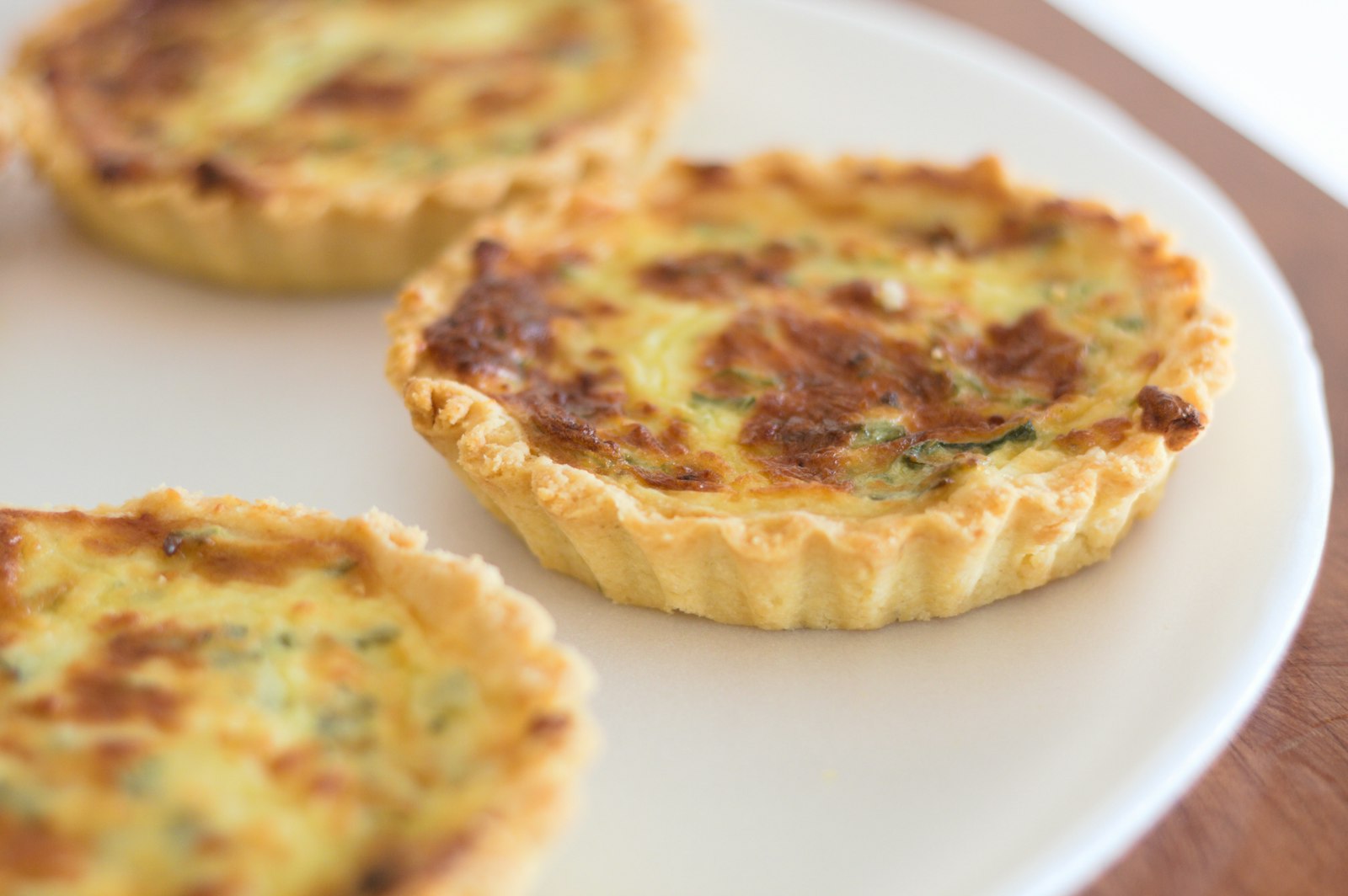
Sourced · Unsplash
iv. If you want to know what you just made
The custard you just whisked, the shell you just improvised or skipped, the machine you just used instead of an oven — none of it is arbitrary. Here is where all three came from.
v. The deep etymology: a word that is already its place
The word quiche has uncertain origins — and France's own lexicographic authority says so plainly. Four dictionaries were checked here, two French and two German. None of them lands on a certain answer, but all four point the same rough direction: quiche is probably, not certainly, a cousin of the word for cake.
- CNRTLCentre National de Ressources Textuelles et Lexicales — France's national lexicographic authority, which hosts the TLFi, the Trésor de la langue française informatisé, "Digitised Treasury of the French Language": origin uncertain, possibly related to German Kuchenpronounced KOO-khen — cake or baked good. Their own wording: "mot d'orig. inc., à rapprocher peut-être de l'all. Kuchen."
- DWDSDigitales Wörterbuch der deutschen Sprache — Germany's authoritative historical dictionary: traces Kuchen back to Old High German kuohho (9th century), part of the wider Germanic kōka-/kaka- word family, with "no certain extra-Germanic connections."
- wissen.de, a German etymological dictionary, independently gives the origin as "unbekannt" (unknown), with a possible link to Kuchen or the Upper German Küchel (small cake).
- Wiktionnaire, citing Alain Rey's Dictionnaire historique de la langue française (2006), is the most specific of the four: it derives quiche from Old Lorrain Frankish Küche / Küeche — "gâteau, tarte," cake or tart.
Two national authorities — one French, one German — independently call this derivation probable, not proven. Only Wiktionnaire, citing a single scholar, states it more confidently. That gap between "uncertain" and "probably this" isn't sloppiness on the article's part — it's the dictionaries' own disagreement, preserved rather than smoothed over.
What is certain: the word is etymologically already a pléonasmeFrench for pleonasm — using more words than necessary where one word already contains the meaning of another when paired with "Lorraine." "Quiche lorraine" is roughly equivalent to saying "Lorraine tart from Lorraine" — the region is encoded in the probable root, then named again. The word entered standard French only in 1805, in Jean-Jacques Lionnois's Histoire des villes vieille et neuve de Nancy (History of the old and new cities of Nancy) — two centuries after it appears in regional Lorrain dialect records.
The dish before the word. On March 1, 1586, a payment appears in the household accounts of Duke Charles III of Lorraine in Nancy — "Baker for échaudés & Quiches, 9 gros" (échaudés = scalded pastries; gros = a silver coin, unit of payment). This is the first documented mention of the dish. The word "quiche" in its current Lorrain-dialect form is first attested nineteen years later, in March 1605, in the account books of the hospice of Saint-Julien in Nancy — this is the record traced by historian Guy Cabourdin. The two records document different things: the dish in 1586, the word in 1605.
The original quiche bore little resemblance to the rich, creamy form now recognised as canonical. As Cabourdin is quoted by French food historians: "la qualité de la quiche lorraine, mince et croustillante, était en fonction de la fraîcheur des produits employés; le lard et l'épaisseur de la migaine ne vinrent qu'au XIXe siècle" — the quality of the quiche lorraine, thin and crispy, depended on the freshness of the ingredients; the lard and the thickness of the custard arrived only in the 19th century. The thick, creamy deep-dish form is not the original.
The geography behind the word. The historical Duchy of Lothringenthe German name for Lorraine straddled a linguistic boundary: its southern and western parts were French-speaking from antiquity; its northeastern parts were German-speaking, with dialects including LothringischLorrain Frankish, MoselfränkischMoselle Franconian, and RheinfränkischRhenish Franconian. After France regained Lorraine in 1918, 250,000 people with German connections were expelled. The dish carries the trace of the German-speaking northeast; the word carried its Frankish grammar into French.
The regional German dialect names for the same dish form a precise linguistic map: Blootzeastern Francian, Tart and KucheRhineland Francian, Kuche = cake, FloosMosellan Francian, SchuediLuxembourgish Francian — the fingerprint of a dish that predated the modern border. The German name most commonly encountered today is Lothringer SpeckkuchenLotharingian bacon cake — Speck = smoked cured pork; Kuchen = cake; Lothringen = Lorraine — a German compound that names the dish by region and primary ingredient rather than by the Lorrain dialect word that passed into French.
The first lexicographic entry of "quiche" appeared as a masculine noun in Bescherelle's dictionary in 1845/1846, with the feminine form recorded only in 1869 by Littré. The Wiktionnaire, citing Alain Rey, gives the English adoption as approximately 1949 — later than the 1925 date that appears in some anglophone sources. These dates come from different scholarly authorities; the discrepancy is not resolved in any open source.
The reason the word is Germanic in a dish France now claims: in the 16th century the region was the Duchy of Lothringen, a Germanic realm. The food memory is older than the flag.
vi. From bread-dough to pâte brisée: the construction of a dish
The oldest quiche used bread dough, not pastry, and had no bacon in it.
Bread-dough phase (16th–18th century). Farmers' wives shaped leftover bread dough into a flat case using the last residual heat of a communal or farmhouse oven after the bread had come out, and topped it with eggs beaten with cream or milk and whatever lardrendered pork fat — distinct from the cured strips later called lardons was to hand. The 1586 dinner served to Charles III likely featured this older form.
A pocket of wonder
The bacon appears (19th century). The shift to pastry coincided with the introduction of smoked lardons. The dish moved from farmhouse to bourgeois table in Nancy and other Lorraine towns, and by the time Auguste Escoffier included it in his Guide Culinaire (Culinary Guide) in 1903, it had entered the canon of French haute cuisine.
What pâte brisée does. Wheat flour's gliadin and gluteninthe two proteins that bond into gluten — the elastic network that gives bread its chew — when hydrated and worked are kept from bonding by fat: in pâte brisée the fat is rubbed into the flour before water touches it, coating the particles and blocking hydration. Butter is roughly 80% fat; that fraction blocks gluten, while its small water fraction supplies just enough steam for flaky layers. The working rule is twice as much flour as butter by weight.
vii. The custard matrix: why quiche is structurally strange
A quiche is not a pie in the English sense and not a pure pastry tart. It is a baked custardeggs, dairy fat, and liquid set by heat into a gel — distinct from stirred custard, which stays a pourable sauce inside a pastry shell, and the shell and filling want opposite things from the oven: dry heat for the crust's Maillard browningthe reaction between proteins and sugars under dry heat that produces browning and flavour — not the same as caramelisation, which needs sugar alone, gentle moist heat for the custard.
Inside the egg mixture, proteins set in sequence as temperature climbs: the white's conalbuminalso called ovotransferrin — the first egg-white protein to set, around 62 °C / ≈ 144 °F, giving the custard its earliest structure first, then ovalbuminthe dominant egg-white protein by mass, and the last to set — around 84 °C / ≈ 183 °F — making it the real determinant of a custard's final texture last and firmest; yolk proteins land between 65–70 °C149–158 °F. Cream raises all these thresholds — a whole-egg-and-cream custard thickens around 80–85 °C176–185 °F and only starts to curdleovercook past the point of a smooth gel, so the protein network seizes and separates from the liquid into visible curds and watery whey past 88 °C190 °F, because milk fat coats the protein network and slows bonding.
The US Food Safety Inspection Service sets a 71 °C160 °F minimum internal temperature for egg mixtures; a standard quiche (40–50 minutes at ≈ 180 °C≈ 356 °F) reaches 79–81 °C174–178 °F at the centre when properly set — well clear of the safety floor and still below curdling. That is a window of only about 10–15 °C18–27 °F between undercooked and curdled, which is why rendering lardon fat, cream ratio, and oven behaviour all matter more than they might seem to.
viii. The border dish: four centuries of contested territory, one recipe
The region that named quiche has changed hands more often than almost anywhere in Europe: Duchy of Lorraine (Germanic) → France (1766) → German Empire (1871, after the Franco-Prussian War) → France (1918) → German-occupied France (1940) → France (1945). Each annexation left a trace.
The 1871 annexation is the one that moved the dish. When the newly unified German Empire claimed Alsace-Lorraine, many residents chose to leave for French cities rather than live under German rule, and they carried their cooking with them: the brasserieoriginally a beer-oriented restaurant type — from French brasser, "to brew" — established in Paris in large numbers by post-1871 Alsatian and Lorraine migrants tradition of Paris owes much to that migration, and quiche Lorraine arrived in the capital on the same route.
From there the path runs provincial → national → international: Paris brasseries after 1871 → Escoffier's Guide Culinaire (1903) → post-war Anglo-American cookbooks. Elizabeth David1913–1992, British food writer whose post-austerity books reshaped British domestic cooking included quiche in French Provincial Cooking (1960), specifically excluded cheese, and called cheese additions cost-cutting modifications she was "scornful of" — a position shared by Simone Beck, Louisette Bertholle, and Julia Child1912–2004, American cooking teacher whose Mastering the Art of French Cooking and TV programmes brought French technique to American home kitchens in Mastering the Art of French Cooking (1961). Child's television advocacy through the 1960s turned it into an American dinner-party fixture.
ix. The cheese wars: an open dispute with a guardian brotherhood
Quiche's cheese question has produced dated, named positions from chefs and writers on both sides across more than a century.
Against cheese: the 1901 Le Figaro recipe had neither cheese nor bacon, only eggs, cream, and pastry; André Theuriet and Edmond Richardin's 1904 published recipe agrees; Elizabeth David (1960) and Julia Child's team (1961) both excluded it. The Confrérie de la Quiche Lorraine codifies the three-ingredient version — eggs, cream, lardons — lobbies for road signs naming Dombasle-sur-Meurthe the "capital of quiche lorraine," and is pursuing UNESCO recognition. Members wear ceremonial robes with a quiche medallion. The Larousse Gastronomique defines quiche lorraine as "tarte garnie d'un mélange d'œufs battus, de crème fraîche et de lardons, servie en entrée chaude" (a tart garnished with beaten eggs, fresh cream and lardons, served hot as a starter) — no cheese.
For cheese: Jules Gouffé1807–1877, French chef, student of Marie-Antoine Carême added Parmesan in 1870; Escoffier (1903) specified Gruyère strips; Marcel Boulestin (1932) specified grated Gruyère; Paul Bocuse1934–2018, a central figure in nouvelle cuisine supported cheese; contemporary chef Philippe Etchebest added cheese to his public recipe in 2023, deliberately triggering what his followers called "#quichegate."
No primary document from Lorraine before the late 19th century mentions cheese. Its arrival is traceable to specific chefs at specific dates — evolutionary, not traditional — but the evolved branch now dominates global production.
x. "Real Men Don't Eat Quiche" — the book, the moment, and the twenty-year silence that followed
In early 1982, American screenwriter and humorist Bruce Feirstein published a slim satirical book titled Real Men Don't Eat Quiche: A Guidebook to All that is Truly Masculine. It had started as a facetious piece in Playboy magazine — Feirstein lamenting that "American men are all mixed up today" — and the book expanded the joke into a running taxonomy of "real men" (steak, pickup trucks, suppressed emotions) against "wimps," or quasi-men, who cooked, cleaned, and backed feminist causes. It was satire. A lot of people didn't notice that it was satire. The phrase broke free from the book and acquired its own life; by the mid-1980s most people repeating it had never read a page of Feirstein's work. The book sat on the New York Times bestseller list for 55 weeks and sold more than 1.6 million copies.
What quiche was doing in American culture before the book.
Quiche had arrived in American restaurants in the 1950s, came into its own in the 1960s through Julia Child's television work, and peaked on brunch menus in the late 1970s. By then, food historian R. H. Cleves — writing in Gender & History (Wiley, 2022) — documents that quiche had already been coded, in particular urban American contexts, as a quintessentially queer dish: it appeared in advertisements in gay weekly newspapers as early as 1971, promising New York City's "finest quiche Lorraine" at a brunch restaurant frequented by gay men. Cleves argues that Feirstein's book "drew on a long tradition of gendered food nationalism in Anglo-American culture that associated French cuisine with effete masculinity," and that the queer-brunch coding was already established before the book named it. In the early 1970s, when gay men in San Francisco and New York were building among the first openly gay commercial cultures — restaurants, bars, community spaces — a French savoury tart with cream and bacon on a Sunday morning was part of the aesthetic vocabulary of that world.
The book's cultural moment.
1982 is not a random year. The Equal Rights Amendment, which would have guaranteed equal rights regardless of sex, had been defeated in 1982 after a decade-long battle, with conservative activist Phyllis Schlafly leading the opposition. The preceding decade had seen second-wave feminism rewrite the expected roles of both men and women — men cooking at home, men sharing childcare, men in therapy were no longer fringe experiments but cultural arguments about what masculinity should look like. The Feirstein book captured what the sociologist R. W. Connell would later call a "crisis of hegemonic masculinity": the older script for being a man was visibly contested, and enormous cultural energy was going into either defending or dismantling it. Two academic papers treat the book as a document of this moment rather than just a comedy: Cleves (2022) in Gender & History and a 2021 paper in the European Journal of American Culture. The food was never really about the food.
The Schlafly quiche.
In January 1983, Schlafly moved the joke into the Senate chamber. She sent homemade quiches — one per senator — to each of the 53 US Senators who had reintroduced the Equal Rights Amendment. Labelling them "Real Men Don't Draft Women," she was doing two things at once: borrowing the Feirstein title to imply the senators who backed the ERA were insufficiently masculine, and linking the ERA's women-in-the-military provision to the quiche's existing queer-and-feminist associations. A UPI wire report from January 26, 1983, describes her labelling the ERA's backers "wimps" — Feirstein's own word — as the quiches were delivered.
A pocket of wonder
What happened to quiche after.
The phrase "real men don't eat quiche" proved more durable than the book. Through the late 1980s, quiche quietly vanished from American restaurant menus — a retreat driven by two converging pressures: the cultural stigma the Feirstein line had attached to it, and the cholesterol panic of the mid-1980s, which targeted egg-and-cream dishes explicitly. A 1997 Deseret News article describes the arc as a "fall" and a tentative "recovery," noting that by the mid-1990s a new generation of home cooks was rediscovering the dish, often through lower-fat adaptations. The rehabilitation was slow and incomplete. What replaced it, eventually, was the air fryer trend of the 2020s: a younger audience encountering the same egg-and-pastry logic through a completely different machine, detached from the cultural freight of the '80s.
xi. The air fryer: instrument, inventor, and irony
The man usually credited. In his workshop on the Creative Campus at Bolderweg op de Vaart in Almere, Netherlands — a city purpose-built in the late 1970s on reclaimed land east of Amsterdam — Fred van der Weij1962 or 1963–2022, Dutch product developer was experimenting with a fan and a heating element. Inspired initially by a neighbour's conversation about healthier cooking, he had set out to build an appliance that could produce crispy food without oil immersionsubmerging food entirely in oil heated to 160–190 °C / 320–374 °F, where hot oil forces moisture out through steam pressure and simultaneously penetrates the food's surface layers — a moisture-displacement chemistry that produces the characteristic texture of deep-fried food, which air alone cannot replicate, and found existing options inadequate in both taste and speed. His first prototype was crude: a frame of wood and mesh, something the BBC later described as nearly the size of a dog house. Later iterations added the removable basket. He called his invention "Fritair" before the name evolved into "airfryer." He took it to Braun, who declined it. Philips — already struggling with their own air-frying prototype — is the company that actually turned his patent into a product: they took an exclusive licence on it in 2005–06 and launched the result as the Airfryer, with their Rapid Air Technologya forced-convection design: a radiant element above the food chamber, a high-speed fan circulating air down and back up, stripping the insulating steam layer off food surfaces faster than a standard convection oven branding, at Berlin's IFA electronics fair in 2010. Van der Weij died of cancer in 2022. By then, Philips had already sold their home-appliances division to the Chinese investment group Hillhouse Capital in 2021 — a transaction van der Weij called "something you could certainly call sad... a purely Dutch product has come to an end." Approximately one billion units have been sold worldwide; roughly one in eight Dutch households owns one.
An earlier, independent claim. Van der Weij is the name most often credited as the air fryer's inventor, but he was not the first person to patent the idea. American engineer Chad Erickson developed a concept for oil-free hot-air frying in the 1980s and received a US Patent Office grant in 1989 — sixteen years before van der Weij's European work. The two engineering paths appear to have been independent; no open source resolves whether Philips's patent licensing was aware of, or related to, the Erickson patent.
The company that got there first. While van der Weij's patent underlies the Philips Airfryer, Groupe SEB — the French industrial group founded in Selongey, Burgundy in 1857 by tinsmith Antoine Lescure, and now the world's largest cookware manufacturer (Tefal, Moulinex, Rowenta, Krups, and All-Clad are all SEB brands) — got a commercial air fryer to market four years earlier. Their Actifrya paddle-driven, oil-mist design — a different geometry from Philips's basket, using a rotating arm to toss food as it cooks launched in France in 2006, cooking 1 kg2.2 lb of fresh chips on a single spoonful of oil, and sold more than 8 million units by 2015. The exact legal relationship between van der Weij's patent and the SEB Actifry is not documented in any open source.
A pocket of wonder
xii. The technology: what an air fryer is and what it is not
An air fryer is a small, tightly engineered convection ovenan oven with a fan that actively circulates heated air for faster, more even cooking than radiant heat alone. Heating elements run 800–1,800 W (≈ 0.8–1.8 kW) against a full oven's 2,000–5,000 W (≈ 2–5 kW); the chamber holds 2–6 litres (≈ 0.5–1.6 US gal) against a full oven's 50–80 litres (≈ 13–21 US gal); preheat is 1–3 minutes rather than 10–20. Smaller volume and faster air turnover mean it reaches temperature faster and burns less energy per task — roughly a 3.4× advantage over a conventional oven for comparable small-volume cooking (20 min at 1,400 W / 1.4 kW ≈ 0.47 kWh, versus 40 min at 2,400 W / 2.4 kW ≈ 1.6 kWh, including preheat).
What it is not is a deep-fat fryer. The "crispy" result of air frying is Maillard browning by rapid surface dehydration, not oil-in-surface-layer chemistry. Quiche never needed deep frying in the first place — the air fryer is simply a faster, smaller oven doing an oven's job.
xiii. Why quiche and the air fryer suit each other
A conventional-oven quiche bakes at 175–190 °C347–374 °F for 30–50 minutes; the main risk is the thin exposed pastry edge over-browning while the deep, wet custard centre stays liquid. In the small chamber of an air fryer, that risk shifts rather than disappears: the faster, closer, higher-velocity airflow overdoes the pastry edge unless the temperature is dropped (typically to 160–163 °C≈ 320–325 °F) and, for the last stretch, the rim is shielded with foil. Blind-baking a pastry shell follows the same logic — 160–163 °C320–325 °F for 8–10 minutes weighted, then a further 3–5 minutes unweighted to dry the base.
The safe-doneness numbers hold in the smaller chamber too — 71 °C160 °F minimum, 79–81 °C174–178 °F at a proper set (per the USDA/FSIS egg-dish safety study linked in Sources) — but because surface heating is more aggressive, the edges can hit 85–90 °C185–194 °F while the centre is still 65–70 °C149–158 °F. The jiggle test — firm edge, faint wobble in the middle — reads the same regardless of which box you're cooking in.
xiv. Who adopted the air fryer, and why
The UK: a cost-of-living appliance. British uptake from 2021–2024 tracks the energy price cap crisis directly — household bills nearly tripled for many families, and the air fryer's efficiency became a real financial argument. By 2024, 58% of UK adults owned one (up from 46% the year before), a third had mostly stopped using their conventional oven, and 32% of owners reported a measurable drop in their energy bill.
South Korea: small kitchens, high-tech appetite. Penetration approaches 50%, comparable to the US and China — driven by apartment kitchen size rather than health framing. The compact basket type (64% of Korean ownership) suits small counters better than the paddle-driven Actifry. Korean recipes extend the format to jeonsavoury pancakes, traditionally pan-fried in oil and tteokrice cakes, alongside Western imports like quiche.
The US: health reframing, then pandemic acceleration. Household penetration sits between roughly 36% and 60% depending on the estimate; the 2020–2021 home-cooking surge pushed TikTok's #AirFryerRecipes past 1.8 billion views and top-selling models up more than 3,000% year on year.
Japan: the exception. Penetration is around 4.2% — the lowest of any major market measured. Market research firm Global Market Surfer attributes this to a structural mismatch, not disinterest: traditional Japanese cooking leans on simmering (nimonosimmered dishes — vegetables, meat, or fish slowly cooked in a seasoned dashi-based broth and odena specific winter simmered dish of fish cakes, eggs, and vegetables in dashi broth) and grilling (yakizakanagrilled fish, typically salted and cooked whole) — methods convection air doesn't improve — and Japanese kitchens are small enough that a single-function appliance has to earn daily use.
France. The country that named quiche adopted the air fryer through its own champion, the Groupe SEB Actifry; French-language recipe sites (platsairfryer.fr, meilleur-airfryer.fr) now carry quiche recipes built for it, and French usage still frames the device as a friteuse à air chaud (hot-air fryer) — a name that keeps the frying identity even as the technology has left oil behind.
Germany. German-language sources use the term Heißluftfritteusehot-air fryer — Heiß = hot, Luft = air, Fritteuse = fryer rather than the anglicised "Airfryer."
A pocket of wonder
The Netherlands. The country that invented the air fryer is also among the markets where it has found a comfortable home: roughly one in eight Dutch households now owns one, and the appliance is sold there with the quiet local pride of a home-grown product.
xv. What the viral format actually did
Zoom back in from that country-by-country adoption picture to the one dish that opened this article: the tortilla quiche that circulated on TikTok in 2023–2024. It wasn't engineered by a chef — it was engineered by a platform. It needs no blind-baking, no resting, no pastry skill, turns around in about 20 minutes against a traditional quiche's roughly 90, and photographs cleanly in the high-contrast light a food video wants. Structurally it is identical custard chemistry in a different, disposable vessel: a baked egg custard set by an air fryer's convection inside a high-heat-tolerant flatbread instead of a pastry shell. The history behind it is twenty years old, not four hundred.
A pocket of wonder
xvi. What's contested & unknown
The 1586 and 1605 documents. The 1586 reference — a payment for "échaudés & Quiches, 9 gros" in the household accounts of Duke Charles III of Lorraine in Nancy — is cited across French-language sources as the first documented mention of the dish. The 1605 reference is the first use of the word "quiche" in its current Lorrain-dialect form, traced by historian Guy Cabourdin to the account books of the hospice of Saint-Julien in Nancy. Full primary text of neither document is accessible as an open source. Whether the 1586 payment uses the word "quiche" or names the dish under an earlier term is not resolved.
The etymology. The CNRTL gives the origin of "quiche" as uncertain, possibly related to German Kuchen. The German etymological dictionary wissen.de also gives "unknown." The Wiktionnaire (citing Alain Rey) gives a more specific derivation from Old Lorrain Frankish Küche / Küeche. These are different authority levels within the same probable derivation chain — they agree on the likely Germanic root but disagree on how confidently to state it.
English first attestation — 1925 or 1949? The Wiktionnaire (citing Alain Rey's Dictionnaire historique (2006)) gives approximately 1949. Some anglophone sources give 1925. These dates come from different scholarly authorities; the discrepancy is not resolved in any open source.
Groupe SEB vs. Philips priority. Sources consistently place the SEB Actifry as the first commercial air fryer (2006), while crediting Fred van der Weij as inventor and Philips as the globaliser (2010). The exact legal relationship between van der Weij's patent and the SEB Actifry is not documented in any open source.
The Chad Erickson / van der Weij relationship. Chad Erickson's 1989 US patent for oil-free hot-air frying predates van der Weij's European work by sixteen years. Whether the two paths were fully independent, or whether Philips's licensing was aware of the Erickson patent, is not documented.
The cheese question's actual first appearance. Jules Gouffé added Parmesan in 1870, and Escoffier codified Gruyère in 1903. Whether regional Lorraine practice included cheese in any form before 1870 is not resolved by any open primary source.
R. H. Cleves's full argument (Gender & History, Wiley, 2022) is paywalled. The abstract confirms the subject; the full article is behind the Wiley paywall. The 2021 paper in the European Journal of American Culture (Intellect Discover) is similarly paywalled.
Air fryer and nutrient retention. No academic study comparing nutrient retention in quiche baked in an air fryer versus a conventional oven was found. The energy-efficiency figures are consumer analysis, not peer-reviewed comparison.
xvii. The names, across languages
- Frenchquiche lorraine / quiche
- From the Lorrain-Franconic dialect; "lorraine" is etymologically redundant but retained. First in standard French 1805 (Lionnois).
- Lorrain-Franconic (historical)Küche / Küeche / Kichel / Kich
- Forms documented in the region; Küche = kitchen, Küeche/Kichel = cake or tart — the CNRTL calls the derivation uncertain, perhaps related to German Kuchen
- Regional German dialects (historical, in Lorraine)Blootz (eastern Francian) · Tart, Kuche (Rhineland Francian) · Floos (Mosellan Francian) · Schuedi (Luxembourgish Francian)
- Dialect forms recorded in French Wikipedia's Quiche Lorraine article — the linguistic fingerprint of the Germanic northeast of the old duchy
- German (modern standard)Quiche Lorraine / Lothringer Speckkuchen
- Lothringer = Lotharingian/Lorraine; Speck = smoked pork belly; Kuchen = cake — foregrounds geography and ingredient rather than the Lorrain dialect word
- DutchQuiche Lorraine / quiche
- Arrived with French cuisine; Philips globalised the airfryer from Dutch soil
- Englishquiche (Lorraine)
- First attested approximately 1949 per Alain Rey's Dictionnaire historique (some anglophone sources say 1925 — dispute unresolved); now genericised to mean any savoury custard tart
- Korean키쉬 (ki-shi)
- Phonetic approximation; used in café menus alongside French-origin pastries
xviii. Glossary — every term gathered
Every term also feeds the site-wide glossary — tap a word there to find every rabbit hole that uses it.
- quiche
- from Lorrain-Franconic dialect; the CNRTL gives the origin as uncertain, possibly related to German Kuchen; first attested in the word's current form 1605 in Lorrain dialect records; in French 1805; English disputed 1925 or c.1949; an open-faced savoury tart with a custard filling baked in a pastry shell.
- savoury tart
- a pastry case, open on top, no lid, containing a savoury rather than sweet filling; quiche is a savoury tart where the filling is a baked egg custard.
- terroir
- French for "the land"; the folk idea that a dish or product is authentic because it grew from local soil and local hands, village before château.
- migaine
- pronounced mee-GAYN; the traditional Lorraine dialect term for the egg-and-cream custard filling of a quiche; predates the modern standardised recipe.
- frittata
- Italian egg dish, no crust; eggs mixed with fillings, started in a skillet on the hob and finished under the grill or in the oven; firmer than quiche, without dairy in the custard ratio.
- tarte flambée
- also called flammekueche in Alsatian; a thin Alsatian dough baked at very high heat in a wood-fired oven, topped with fromage blanc, onions, and bacon; a relative of what the 1605 quiche in Nancy may have resembled.
- pléonasme
- French for pleonasm: using more words than a meaning strictly requires, where one word already contains what a second word repeats. "Quiche lorraine" is probably an example — both the CNRTL and DWDS trace the word's probable root to a Germanic cake-name native to Lorraine, meaning the region is encoded in the word and then named again.
- pâte brisée
- French short-crust pastry: a fat-rich, minimally water-worked dough where butter coats flour before hydration, preventing gluten development; the standard pastry shell for quiche; crumbly and tender rather than chewy.
- lardons
- small rectangular-cut strips of cured smoked pork belly, used in quiche Lorraine; the fat renders into the custard during baking; distinct from English bacon rashers in cut, cure, and fat content.
- baked custard
- a mixture of eggs, dairy fat, and liquid set by thermal coagulation of egg proteins through oven heat, producing a gel; distinguished from stirred custard, which remains a sauce.
- conalbumin
- also called ovotransferrin; the first egg-white protein to set, around 62 °C144 °F, giving a custard its earliest structure.
- ovalbumin
- the dominant protein in egg white, approximately 54% of albumen protein; sets at approximately 84 °C183 °F, the last and firmest egg-white protein to coagulate; the final determinant of custard texture in quiche.
- curdle
- to overcook a custard past the point of a smooth gel, so the protein network seizes and separates from the liquid into visible curds and watery whey.
- gliadin and glutenin
- the two wheat flour proteins that, when hydrated and mechanically worked, bond to form gluten, the elastic network responsible for chewiness in bread; kept minimal in pâte brisée by fat coating the flour particles before water contact.
- Maillard reaction
- a dry-heat chemical reaction between proteins and reducing sugars that produces complex flavour compounds and brown colour; occurs on the exterior surface of baked quiche crust; distinct from caramelisation, which requires sugars only; requires temperatures above approximately 140 °C284 °F.
- Rapid Air Technology
- Philips' trademarked name for a forced-convection air-frying design: a radiant element above the food, a high-speed fan circulating air from top downward and deflecting back upward, creating a thin, fast-moving air boundary that removes the insulating steam layer from food surfaces.
- convection oven
- an oven equipped with a fan to actively circulate heated air, enabling faster and more even cooking than radiant heat alone; an air fryer is a compact, high-velocity convection oven.
- blind baking
- pre-baking a pastry shell without filling, typically weighted with pie weights, dried beans, or rice over parchment paper to prevent puffing; ensures the base is cooked and dry before a wet custard filling is added.
- Confrérie de la Quiche Lorraine
- Brotherhood of the Quiche Lorraine; a gastronomic fraternity based in Dombasle-sur-Meurthe, Meurthe-et-Moselle; reconstituted 2015 on the 40th anniversary of the Fête de la Quiche; guardians of the three-ingredient authentic recipe — eggs, cream, lardons; pursuing UNESCO cultural heritage recognition.
- Actifry
- Groupe SEB's brand of air fryer, launched 2006; among the earliest commercial air-frying products to market; uses a rotating paddle and oil mist rather than the Philips basket design; 8 million+ units sold by 2015.
- Heißluftfritteuse
- German compound noun for air fryer, literally "hot-air fryer" (Heiß = hot, Luft = air, Fritteuse = fryer); the standard German-language term, preferred over the anglicised "Airfryer" in German-speaking markets.
- deep-fat frying
- submerging food in oil heated to 160–190 °C320–374 °F; the oil forces moisture out through steam pressure and simultaneously penetrates the food's surface layers, producing the characteristic texture of fried food; a moisture-displacement chemistry that air alone cannot replicate.
- tortilla quiche
- a social-media-circulated improvised form, popularised 2023–2024 on TikTok and Instagram; a flour tortilla substituted for the pastry shell, pressed into a mould, air-fried, and filled with an egg custard; not recognised as quiche by purist standards.
- nimono
- a category of traditional Japanese simmered dishes: vegetables, meat, or fish slow-cooked in a seasoned dashi-based broth.
- oden
- a specific Japanese winter dish within the simmered/nimono family: fish cakes, boiled eggs, daikon, and other ingredients slow-cooked together in a dashi broth.
- yakizakana
- Japanese grilled fish, typically salted and cooked whole over direct heat.
- jeon
- Korean savoury pancakes, traditionally pan-fried in oil; adapted to air-frying to cut oil use.
- tteok
- Korean rice cakes, a staple food with broad cooking versatility, from steaming to grilling to air-frying.
- brasserie
- a French restaurant type, originally beer-oriented; the word derives from brasser, to brew; brasseries were established in Paris in large numbers by Alsatian and Lorraine migrants after the 1871 annexation, and quiche Lorraine arrived in Paris on the same migration.
- CNRTL
- Centre National de Ressources Textuelles et Lexicales; France's national lexicographic authority, operated by the CNRS; hosts the TLFi, the Trésor de la langue française informatisé; the canonical first-resort for any French etymology claim.
- DWDS
- Digitales Wörterbuch der deutschen Sprache; Germany's authoritative historical dictionary, operated by the Berlin-Brandenburg Academy of Sciences; traces words to Old High German and Proto-Germanic; the parallel authority to the CNRTL for German.
19. Provenance
- Languages
- EN · FR · NL · DE
- Open questions
- see “What’s contested & unknown” above
- Full source notes
- in the detailed view under Sources
- Recorded
- 2026-07-04
20. Sources
Most reputable and openable first. The full list — every source with its note, plus the paywalled, citation-only and secondary ones — is in the detailed view.
- Tier 1 (lexicographic authority) · open · read in original (Français)CNRTL — TLFi: Étymologie de quiche read in original
- Tier 1 (lexicographic authority) · open · read in original (Deutsch)DWDS: Kuchen read in original
- Primary · open · read in original (video caption)TikTok / @thetummyfairy: Airfryer Cheat's Quiche Hack read in original
- Tier 3 · open · read in fullThe Typical Mom / temeculablogs.com: Air Fryer Quiche
- Tier 3 · open · read in fullEffortless Foodie: Air Fryer Crustless Quiche Lorraine
Every source, with notes (46)
- Tier 1 (lexicographic authority) · open · read in original (Français)CNRTL — TLFi: Étymologie de quiche read in originalFrance's national lexicographic authority. Gives origin of "quiche" as "uncertain, possibly related to German Kuchen." Records the 1605 Lorrain attestation and the 1805 first appearance in central French. Entry reviewed by Éva Buchi, Thomas Städtler, and Pierre Rézeau. Read in original French.
- Germany's authoritative historical dictionary. Records Kuchen from Old High German kuohho (9th century); "no certain extra-Germanic connections." Read in original German.
- Primary · open · read in original (video caption)TikTok / @thetummyfairy: Airfryer Cheat's Quiche Hack read in originaloriginating viral tortilla quiche; full ingredient list and method from the creator's own caption. Corroborated as the trend's origin point by @littleloucooks crediting her by name. Card 4 / Hype.
- Tier 3 · open · read in fullThe Typical Mom / temeculablogs.com: Air Fryer QuicheJustine's crustless quiche; three-egg single-serving format; 325 °F≈ 163 °C, 8–10 minutes. Family cooking blogger since 2012, raises chickens. Card 1 / Simple.
- Tier 3 · open · read in fullEffortless Foodie: Air Fryer Crustless Quiche LorraineBeth Sachs's crustless Lorraine variant; pancetta, cream, Parmesan; 180 °C356 °F, 20–25 minutes. Cornwall-based home cook. Card 2 / Practiced.
- Tier 3 · open · masterclassThe French Cooking Academy: Authentic Quiche LorraineStéphane's canonical three-ingredient recipe (eggs, cream, lardons, no cheese). Self-taught from French culinary school textbooks in Australia. Card 3 / Expert.
- Tier 2 · open · institutionaldelicious. magazine: Air fryer quicheUK food-magazine shortcrust pastry-shell quiche adapted for the air fryer; blind-baking and fill temperatures confirmed via search result content (direct fetch 403).
- Tier 1 candidate · open (NIH/PMC)Reed et al. (2017): Food Safety — Recommendations for Determining Doneness in Consumer Egg Dish RecipesUSDA/FSIS-sourced research; quiche internal temperatures at safe doneness (79–81 °C≈ 174–178 °F).
- Gives the derivation as "du vieux-francique lorrain Küche, Küeche — gâteau, tarte," citing Alain Rey (2006). Gives English adoption as approximately 1949. Read in original French.
- 1586 Charles III household account as first documented mention of the dish; Guy Cabourdin quoted on the original thin form; dialect name variants (Blootz/Floos/Tart/Schuedi). Read in original French.
- German Wikipedia on quiche: dates the word to "around 1845"; lists regional German variants. Read in original German.
- Confirms the dialect map (Lothringisch / Moselfränkisch / Rheinfränkisch in northeastern Lorraine); the 1918 expulsion of 250,000 German-connected residents. Read in original German.
- Documents Chad Erickson's 1980s oil-free hot-air frying concept and 1989 US patent; van der Weij's 2005 European work; Philips's 2010 commercial launch. Erickson patent absent from anglophone accounts. Read in original German.
- Tier 2 · open · read in original (Français)BLE Lorraine: Origine et véritable recette de la quiche lorraine read in originalFrench-language regional food authority, read in full. First written mention March 1, 1586 (Charles III); no cheese in authentic quiche; Confrérie confirmed.
- Tier 2 · open (Français)Larousse Gastronomique — recette quiche lorraineCanonical recipe: no cheese. Eggs, crème fraîche, lardons, nutmeg. Defines quiche lorraine as "tarte garnie d'un mélange d'œufs battus, de crème fraîche et de lardons, servie en entrée chaude."
- Tier 3 · open (Deutsch)Wortherkunft Quiche Lorraine — wissen.deGerman etymological dictionary: gives origin of quiche as "unbekannt" (unknown). Independently confirms the "uncertain" position held by the CNRTL.
- Tier 3 · open · read in original (Nederlands)Nederlands Dagblad: De man achter de airfryer read in originalvan der Weij's sadness at the Philips → Hillhouse Capital sale: "a purely Dutch product has come to an end." Workshop in Almere confirmed.
- Tier 3 · open · read in original (Nederlands)Almere Zaken: De airfryer — hoe een Almeerse uitvinding de wereld veroverde read in originalCreative Campus / Bolderweg op de Vaart workshop confirmed; Philips took an exclusive licence (not outright purchase); taste as the inventor's non-negotiable criterion.
- Tier 3 · open · read in original (Nederlands)New Scientist NL: De uitvinding — de airfryer read in original1 in 8 Dutch households owns an air fryer; original name "Fritair"; 2005 start date.
- Tier 3 · open · read in original (Nederlands)Pannenman.nl: Wie heeft de airfryer uitgevonden? read in originalBBC's "dog house" prototype description confirmed; removable basket as a later iteration; Philips patent licensing timeline.
- Tier 2 · open (abstract)ResearchGate: Cleves (2022) abstractAbstract confirms quiche was "quintessentially queer" in 1970s American brunch culture; 1971 NYC gay newspaper advertisement cited.
- 1605 attestation, custard history, cheese debate with dates, cultural politics.
- Classic ingredients, cheese debate with named dates and chefs, the Confrérie.
- Technology mechanism, Rapid Air Technology, SEB Actifry 2006 vs. Philips Airfryer 2010, UK adoption statistics.
- Inventor biography; born 1962/1963, died 2022 of cancer; patent licenced exclusively to Philips.
- Tier 2 · openCustard tart — WikipediaMedieval antecedents: The Forme of Cury (14th century), doucettes/darioles; Henry IV's coronation banquet (1399). --- ─── ROUTING ─── destination: fool
- Secondary · open (Deutsch)Vom Nischen- zum Massenprodukt — Handelsblatt/DPA5.8 million Heißluftfritteuse units sold in Germany in 2023 (per NIQ); up from 1.3 million in 2019; market revenue approaching €200M in 2024.
- Secondary · open (Deutsch)Die Geschichte der Heißluftfritteusen — food-monitor.deGerman food-industry site: Chad Erickson concept (1980s, US patent 1989); Philips 2010 launch.
- Secondary · open (Français)Myparisiankitchen.com: Origine et histoire de la quiche lorraineFrench culinary blog; 1586 date cited; etymology to "l'allemand kuchen (gâteau) ou patois lorrain francique küchen"; National Syndicate three-ingredient rule.
- Secondary · openBruce Feirstein, Real Men Don't Eat Quiche — Wikipedia55 weeks on NYT bestseller list; 1.6 million copies sold; Phyllis Schlafly quiche-to-senators anecdote (1983); origin as a Playboy piece; misreception of the satire.
- Secondary · openCulinaryLore: Who said "Real men don't eat quiche"?Feirstein's Playboy origin piece; the satire's misinterpretation; quiche's 1970s trajectory and 1980s stigmatisation.
- Secondary · openDeseret News: A quiche is still a quiche (1997)1997 account of quiche's mid-1990s rehabilitation; cultural stigma + cholesterol fears as the dual drivers of the retreat.
- Tier 1 candidate · abstract only — paywalledCleves, R. H. (2022). "Real Men Don't Eat Quiche: Queer Food and Gendered Nationalism in the Late Twentieth-Century USA." Gender & History, Wiley.Primary scholarly source for quiche-as-queer-food and Feirstein's cultural context. Full text paywalled.
- Tier 1 candidate · abstract only — paywalledDafoe, J. & co. (2021). "Real men don't eat quiche, do they?: Food, fitness and masculinity crisis in 1980s America." European Journal of American Culture, Intellect.Document of 1980s gender crisis and Cold War + fitness-trend context. Full text paywalled.
- Secondary · open (Français)Wikipedia Friteuse à air chaud (French)SEB Actifry 2006 as first commercial product; Philips 2010 launch. Read in original French.
- Secondary · openFrench Moments Substack: Quiche Lorraine — A Story of Tradition, Bacon, and Cheese HeresyCultural history, etymology, Confrérie de la Quiche Lorraine, 1586 Charles III dinner.
- Named chefs and their positions on the cheese question; the 1871 brasserie migration; #quichegate.
- Japan 4.2% vs. Korea/China/US ~50%; health vs. space vs. convenience motivation differences by market.
- Secondary · openITV News: Air fryers now UK's third most-used appliance (2024)UK 2024 adoption statistics: 58% ownership, 33% no longer using conventional ovens.
- Secondary · open (Français)cuisine-pratique.com: Peut-on faire une quiche dans un air fryer?Temperature and time adaptations for air-frying a traditional quiche.
- Van der Weij / Philips licensing story: Braun declined, Philips already had prototype engineers struggling.
- Secondary · openCoagulation / American Egg BoardInstitutional food-industry source on egg protein coagulation temperatures.
- Secondary · openAgriculture.Institute: Physico-chemical properties of eggsEgg protein denaturation sequence; functional properties in quiche and custard applications.
- Confirmed the narrow 10–15 °C18–27 °F window between set and curdled.
- Secondary · openThe French Cooking Academy — About StéphaneStéphane's background: Fontainebleau, Australia, self-taught from culinary school textbooks.
- Tier 1 candidate · abstract only — paywalledEffect of components and heating on rheological properties of custard (2024). Food Science.Custard rheology and thermal processing; heating time/temperature affect viscosity; full text paywalled.


The fool dares the descent any expert would call beneath them, and comes back up holding the one detail they walked past. The Fool's close